Mobile Phone Technology
Wireless Application Protocol
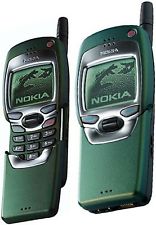
Nokia 7110 - the first mobile to deliver the Internet on the phone.
image ©nokia.comThe mobile internet became available around 1999. The first phones, such as the Nokia 7110, had monochrome screens, limited memory and slow processors, and used either a dial-up GSM network or the later GPRS network. At that time, the 'desktop' internet was well developed. It was unrealistic to expect to be able to use the same TCP/IP - or HTML-based internet on these phones. They did not have the necessary power. To overcome this, the WAP protocol was developed. Designed as a 'lighter' protocol with fewer overheads than TCP/IP, it was less general purpose.
Rather than using HTML, a new language called WML was developed. This was based on the novel concept of a page being a 'deck' of 'cards'. With one call to the server, a number of cards are delivered to the phone, with the first card displayed on the device. Local navigation enables users to move between cards without making another call to the server. The trick, then, was to deliver as many cards as possible in a single server call. However, the 1.4 KB memory limitation ensured that the number of cards remained limited. The WML language enabled text and links to other pages or cards to be displayed. Minimal styling is included. A simple monochrome image format (WBMP) was also specified, but in practice this was not ideal. For input, there was some 'on-phone' validation of data using WMLScript. This also reduced the number of server calls required. The language natively supported making phone calls or sending SMS messages. The scripting language (WMLScript) allows for some local processing, but this is also limited.
Although most WML examples show static code, WML can be generated via PHP and integrated with MySQL or other server-side technologies. It is important to ensure that the server recognises the MIME type of the generated WML. However, despite this dynamic element, many useful WML sites were created before the language was overtaken by events.
Here are some pointers to the future with WAP.
- WML enforces strict XML compliance, making it a better language. HTML has never enforced this, resulting in variations in behaviour, especially when the syntax is 'relaxed'.
- A single server call delivers a number of 'cards', thus reducing the number of calls to the server. While the use of jQuery in an HTML page does not achieve the same result, it can reduce the number of server calls.
- Local validation of user input as is included in Bootstrap
- There is a direct link to phone calls and SMS messages to connect to the native features of the phone.
deepl.com [AI] has been used to improve the text in this description
We may have started to use our mobile phones to make phone calls but now these devices are key to our modern society. We use our mobile phones for directions in a strange city; to access our money through our banking and credit card apps; for tickets to travel whether that is bus, train or air; to watch videos; to take images and buy stuff.
But how does mobile phone technology work? mobilephonetechnology.co.uk seeks to provide information about the technology behind the mobile phone in order to aid understanding and promote more realistic discussions about the technology. Understanding some of the basics of mobile phone technology will help explain how things work and what can and cannot be done with mobile phone technology.
mobilephonetechnology.co.uk is a FREE online resource. Have you found it interesting? You can say thank you and buy me a coffee here. Thank you very much.
w : mobilephonetechnology.co.uk
e :
 Blog
© mobilephonetechnology.co.uk all rights reserved 2017-2026