Mobile Phone Technology
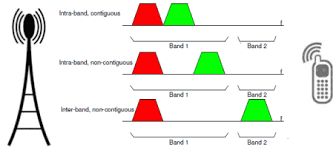
carrier aggregation
image ©telecomabc.comIn a 4G-LTE environment, the available bandwidth is divided into channels, also known as component carriers. These have standard sizes of 1.4, 3, 5, 10, 15 or 20 MHz. Operators split their available bandwidth into these component channels, and users have access to one of these channels. Therefore, 20 MHz is the maximum available. In order to make better use of the narrower channels or increase the available space, a method of combining these component carriers will be needed.
In order to increase the data rate for a given user, there are only two options: widen the channel or combine channels. The latter option is available in 4G+ and is called carrier aggregation. This allows various channels to be combined, up to a maximum of five channels. Therefore, the theoretical maximum channel size is 100 MHz. However, this is only theoretical, as MNOs only have 35 MHz blocks of bandwidth available for the 2.6 GHz 4G network.
- Intra-Band Contiguous Channel: allows the user to access the space on one side of their current allocation. For example, if a user has a 5 MHz channel, they can use one of the adjoining 5 MHz channels to create a single 10 MHz channel. There is also no requirement for space between the two channels, so effectively it is a single 10 MHz channel. This process is known as 'channel bonding'.
- Intra-band non-contiguous channel: add another channel within the same bandwidth for the user's data transfer. This effectively doubles the available space for that user. However, as these channels are not contiguous, there is some overhead in delivering the data this way. The mobile operator has to manage the data between the two separate blocks. Additionally, there will be some 'dead' space in each channel to provide separation between the different channels.
- Inter-band channel: it is also possible to link one channel in one band with another in a second band. This means the user will be using two different bands to send or receive data. To achieve this, two or more serving cells are required for data transmission. The data will take a different path. One of these cells is labelled the 'primary cell' and is used to manage data from the secondary cells. Although this may result in some overhead, it enables the mobile operator to share traffic across all their available bandwidth.
Note that different carrier aggregations can be implemented on the uplink and downlink in order to make the best use of the available bandwidth.
These basics allow for quite complex carrier aggregation to be used. For operators, a large, contiguous bandwidth makes channel aggregation easier and more efficient. Currently, the bandwidth allocated to 4G and 5G operators is small and spread over various bands, which makes carrier aggregation difficult but necessary. It is generally accepted that a contiguous allocation of 100 MHz of bandwidth would make data transmission more efficient. Within the 3.4–3.8 GHz 5G allocation, the bandwidth allocated to an operator was split between two areas due to Ofcom selling the spectrum in two auctions. Following the auctions, some bandwidth swapping took place in this area to give the different operators more contiguous space.
deepl.com [AI] has been used to improve the text in this description
We may have started to use our mobile phones to make phone calls but now these devices are key to our modern society. We use our mobile phones for directions in a strange city; to access our money through our banking and credit card apps; for tickets to travel whether that is bus, train or air; to watch videos; to take images and buy stuff.
But how does mobile phone technology work? mobilephonetechnology.co.uk seeks to provide information about the technology behind the mobile phone in order to aid understanding and promote more realistic discussions about the technology. Understanding some of the basics of mobile phone technology will help explain how things work and what can and cannot be done with mobile phone technology.
mobilephonetechnology.co.uk is a FREE online resource. Have you found it interesting? You can say thank you and buy me a coffee here. Thank you very much.
w : mobilephonetechnology.co.uk
e :
 Blog
© mobilephonetechnology.co.uk all rights reserved 2017-2026